How Do Horses See? Vision, Blind Spots, and Spooking
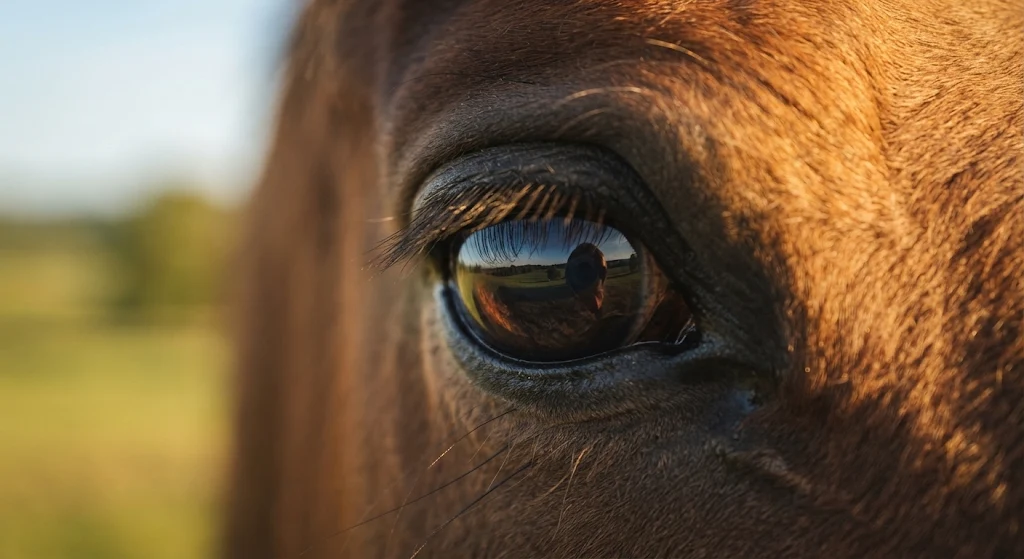
Look into a horse’s eye and you will see a calm, deep, dark gaze. But what is behind it? Horses see the world in a very different way from people, and understanding it explains many behaviors, from spooking at shadows to turning their heads in a funny way.
Big Eyes on the Sides
Horses have some of the largest eyes of any land mammal, set on the sides of the head. This placement gives a very wide field of vision, often described as nearly 350 degrees, so a horse can watch for danger almost all around while grazing.
The trade-off is that they have a smaller area in front where both eyes overlap, which is where depth perception is best.
Blind Spots
Even with such wide vision, horses have blind spots.
- Directly in front of the face, close to the nose
- Directly behind the body, especially the tail area
- Just under the chin and neck
This explains why a horse may not see a hand reaching toward its nose, and why approaching directly from behind is risky.
Why Horses Raise and Lower Their Heads
To focus on near or far objects, horses tilt and move their heads. Raising the head helps them look at distant things, and lowering it helps them check what is close. Don’t be surprised if your horse lifts its head to study a faraway object.
Can Horses See Color?
Yes, but not like us. Horses are generally thought to see two main color ranges, mostly blues and yellows, and may not clearly tell some reds and greens apart. A bright orange cone might look more like a yellowish or dull shade to a horse. They are also good at spotting movement and contrast.
Night Vision
Horses see better than people in dim light, thanks to a reflective layer behind the retina. But their eyes adjust slowly when moving between bright and dark places. A dark trailer entrance, a shadow across the path, or a bright patch on a dim trail can look like a hole or a barrier. That is why horses often hesitate or stop.
Why Do Horses Spook?
Spooking is not stupidity. It is survival. A horse’s instinct tells it to flee first and investigate later. Some common triggers:
- Sudden movement at the edge of the field of view
- Contrast changes, like shadows and puddles
- Unfamiliar objects, such as a plastic bag
- Something on the blind side
Seeing something from one eye and not the other can also change how it looks. A horse that has passed a scary object on one side may spook again if it appears on the other side. This is why training with patience on both sides is useful.
How to Approach a Horse Safely
- Approach from the front or side, where the horse can see you, toward the shoulder.
- Speak softly so the horse knows where you are.
- Don’t walk directly behind a horse. If you must pass behind, stay close and keep a hand on the body, or give a wide berth.
- Offer a flat hand and allow the horse to sniff.
- Move calmly, and avoid sudden gestures.
Helping a Spooky Horse
- Stay calm. Tension in the rider or handler travels down the rein.
- Let the horse look and sniff from a safe distance.
- Introduce new things gradually, using a patient and positive approach.
- Keep sunlight and shadows in mind when planning a ride.
- Check the eyes. If an eye is cloudy, tearing, squinting, swollen, or red, call a veterinarian.
Fun Facts
- A horse’s eyes can move independently in some situations, to look at different things.
- Horses may not see directly below their own nose, so they sometimes find their food by smell and touch.
- Horses rely on whiskers, which may be trimmed in some places, but they are valuable sensing tools.
Conclusion
Horses see a wide, moving world, with blind spots in front of the face and behind the body, a different color range, and slow adjustment to changing light. Knowing this makes handling safer and helps you understand the reason behind a startled reaction. Next time your horse stops at a shadow, remember that it sees something different from what you do.
FAQ
1. Can horses see in the dark?
They see better than humans in low light, but their eyes adjust slowly to sudden changes between bright and dark.
2. What is a horse’s blind spot?
Directly in front of the nose and face, directly behind the tail, and under the chin.
3. Why does my horse stop at shadows?
Contrast changes can look like holes or obstacles, and horses are cautious by instinct.